In the 1870s, a Bradford-born engineer turned the basement of his Harrogate home into a laboratory that would change street lighting forever. Samson Fox's experiments with water gas would make Parliament Street the first route in the world to be illuminated by this revolutionary technology.
From Mill Worker to Mayor
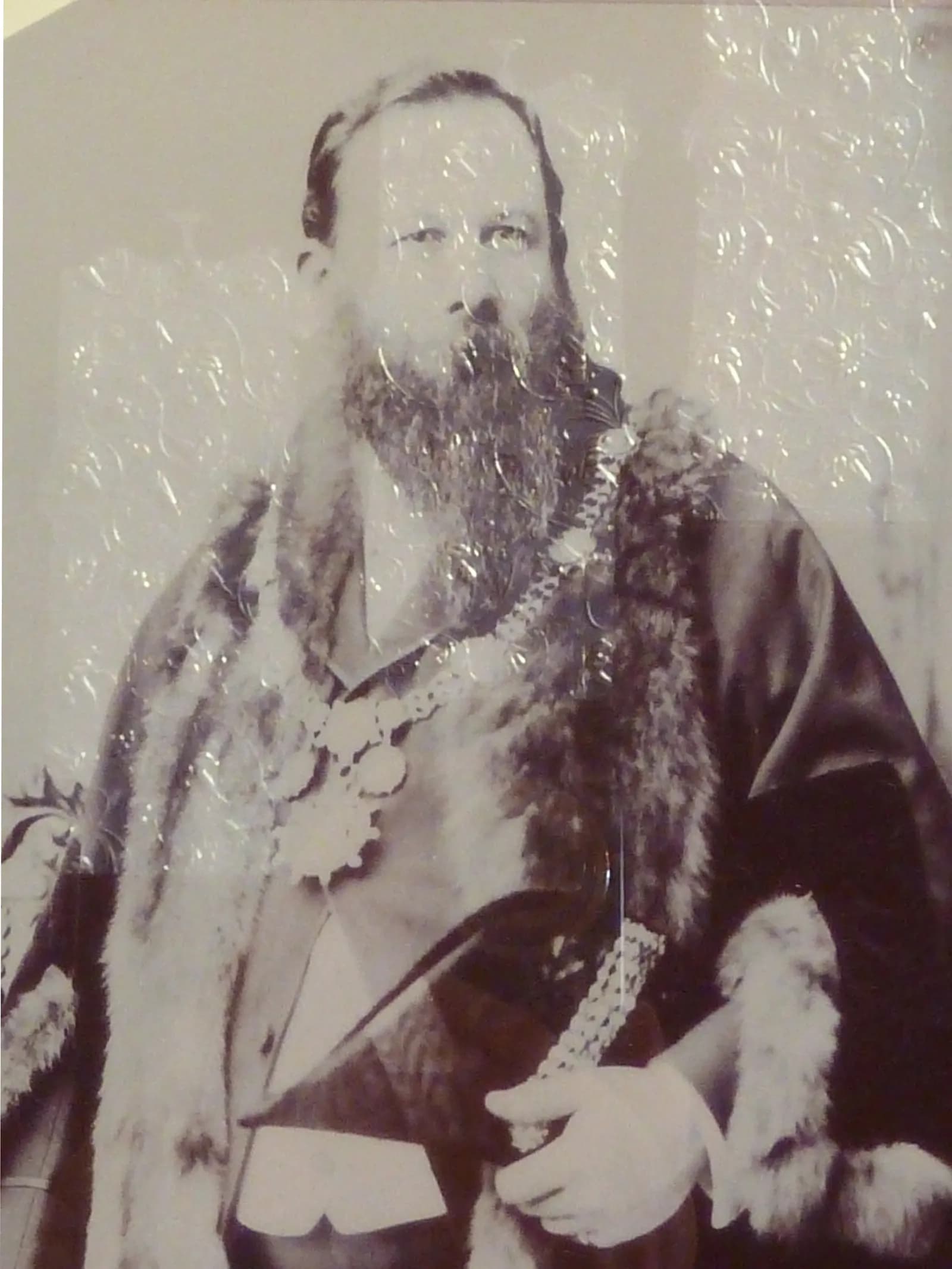
Samson Fox was born on 11 July 1838 in Bowling, Bradford, to a family of modest means. His father worked in the mills, and young Samson began his own factory life at the age of eight. Despite these humble beginnings, he would rise to become one of the most influential figures in Victorian Harrogate, leaving a legacy that endures in the town's architecture, institutions, and even its gene pool.
Fox made his fortune through engineering. In 1877, he invented the corrugated boiler flue, a design that improved heat transfer and compressive strength so dramatically that it was adopted by the Admiralty and major steamship lines worldwide. The invention earned him a gold medal from the Royal Society of Arts and the French Legion of Honour.
In 1882, Fox purchased Grove House on Skipton Road in Harrogate. The property became both his family home and his laboratory. It was here, in the basement, that he perfected the water gas process in 1870. This experimental plant made Grove House the first residence in Yorkshire to have gas lighting and central heating. Contemporary newspapers marvelled at the achievement, with one declaring that "Samson Fox has captured the sunlight for Harrogate."
Lighting Parliament Street
Fox's water gas process involved passing steam over hot carbon to produce a mixture of hydrogen and carbon monoxide that burned with a bright, clear flame. The technology was cleaner and more efficient than the coal gas commonly used for street lighting at the time.
In the 1880s and 1890s, Fox built a water gas plant that supplied the entire town. Parliament Street became the testing ground for this innovation, earning the distinction of being "the world's first route to be lit by water-gas." The bright illumination transformed the shopping street into a beacon of Victorian progress, drawing visitors and setting a standard that other towns would eventually follow.
The achievement was not without controversy. Water gas faced opposition from established coal gas companies and even attracted criticism from the writer Jerome K. Jerome. Fox defended his invention vigorously and was ultimately vindicated, though the coal gas industry would remain dominant for decades to come.
Civic Legacy
Fox's contributions to Harrogate extended far beyond lighting. He served as Mayor for three successive years from 1890 to 1892, a record that has never been equalled. During his tenure and beyond, he funded numerous civic improvements including Grove Road School, affordable social housing, and Harrogate's first steam-powered fire engine.
His most visible legacy is the Royal Hall, originally opened in 1903 as the Kursaal with Fox's support. The Grade II* listed building, designed by the celebrated theatre architect Frank Matcham, underwent a £10.7 million restoration between 2006 and 2008 and was reopened by Prince Charles on 22 January 2008. The venue remains a cornerstone of Harrogate's cultural life.
Fox was also a significant philanthropist on the national stage. Between 1892 and 1894, he donated £45,000 to build the Royal College of Music in London, a sum equivalent to over £5 million today. A bust of Fox still greets visitors in the entrance hall.
The Fox Dynasty
Fox died on 24 October 1903 in Walsall, Staffordshire, leaving an estate valued at £156,722, approximately £16.5 million in today's terms. His descendants include some of Britain's best-known actors: Edward Fox OBE, James Fox OBE, Emilia Fox, Freddie Fox, and Laurence Fox.
Freddie Fox, Fox's great-great-grandson, described him in 2022 as having "a sort of Elon Musk quality... a totally self-made man who used his money for the community." Playwright Gavin Collinson, who researched Fox for a 2022 theatrical production, noted that "his projects were all big and bold... He was all about safer transport, better public lighting, cheaper rail travel."
What Remains Today
Grove House, where Fox conducted his experiments, still stands on Skipton Road. The Grade II* listed building, with parts dating to 1754, is now a private residence and events venue. Between 1898 and 1902, Fox added an east wing containing a music room, ballroom, and art gallery. The extensions reflect the grandeur of his vision for both his home and his adopted town.
Parliament Street remains one of Harrogate's principal shopping thoroughfares, lined with Victorian buildings including the celebrated Betty's Tea Room. Though the water gas lamps are long gone, replaced by modern lighting, the street's layout and many of its architectural features date from Fox's era. The Westminster Arcade, an opulent Victorian shopping arcade, continues to serve shoppers much as it did when Fox was mayor.
Remarkably, Harrogate has no blue plaque commemorating its three-time mayor and greatest benefactor. His memorials are the buildings he funded and the streets he illuminated, physical testaments to an era when a Bradford mill worker could capture the sunlight and transform a Yorkshire spa town.